
Predicting Gastrointestinal Toxicity
GI toxicity is a leading cause of clinical adverse events, yet most preclinical models consistently fail to flag it. The MIMETAS OrganoReady® Colon Organoid gives you a human-relevant readout you can act on — as a ready-to-use plate you run yourself, or as a fully outsourced and standardized OrganoServices study.
OrganoReady® Colon Organoid in numbers
Conventional Models Fall Short,
OrganoReady® Revolutionize GI Tox Predictions
Animal studies and standard 2D cell lines don't replicate the polarized, perfused epithelium of the human gut. The result: GI liabilities that pass preclinical screening only to surface in Phase I or later. The OrganoReady® Colon Organoid replicates the gut physiology, giving you predictions that correlate with real clinical outcomes so you can de-risk and prioritize compounds with confidence. Because it can be dosed apically and basolaterally independently, you can test oral and systemic exposure in the same model, without switching assays.





Validated Platform,
Move with Confidence into Your Next Development Stage
GI liabilities missed by rodents and traditional cell lines surface when stakes are high: close to, or during clinical trials. In a head-to-head against Caco-2 in Transwell®, the OrganoReady® Colon Organoid performed better with 78% sensitivity versus 56% sensitivity for Caco-2, both at 92% specificity. Taken together, the OrganoReady® Colon Organoid yields a more defensible basis for advancing or deprioritizing compounds earlier in the program.
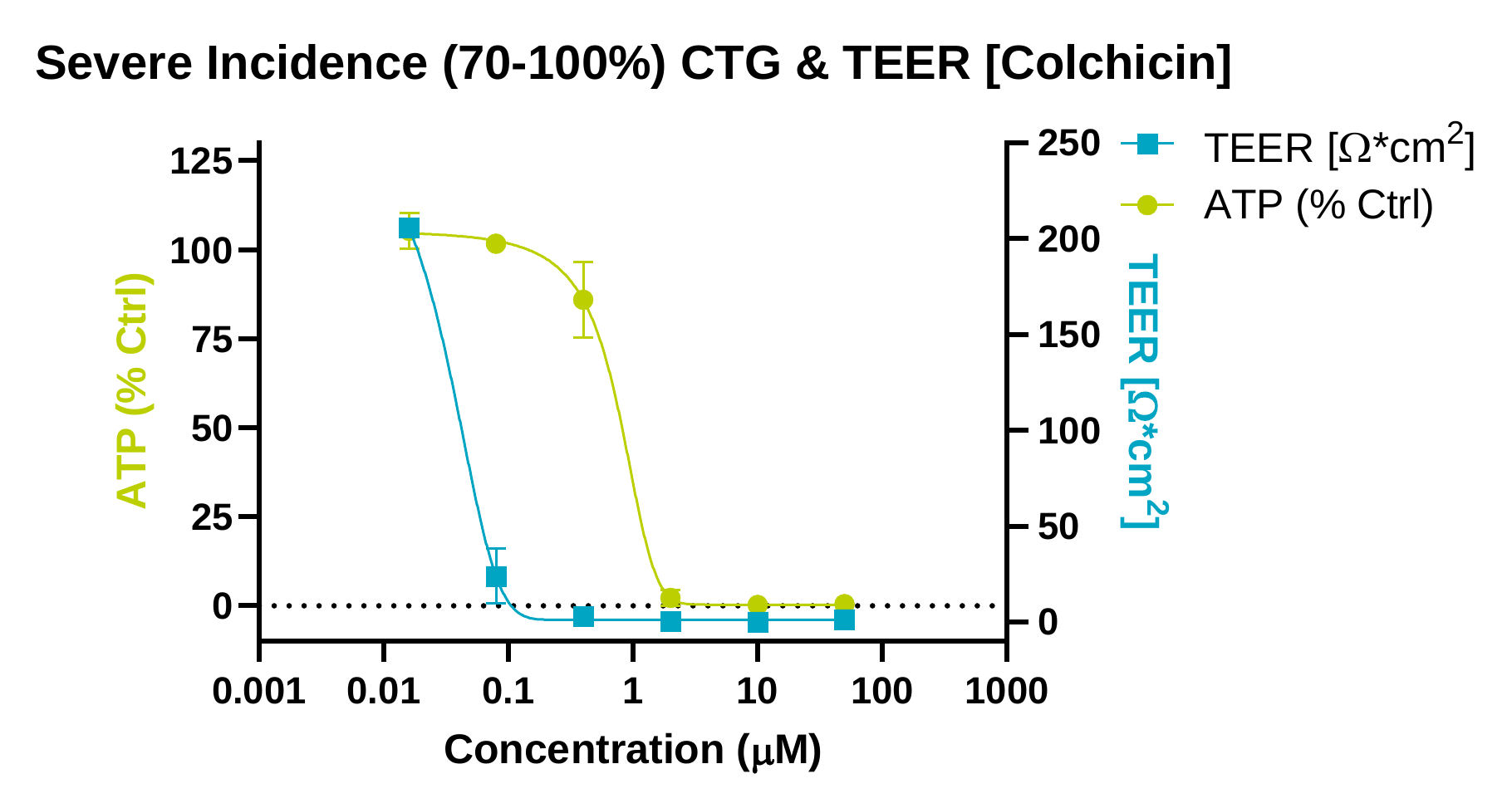
Callout: colchicine was flagged at submicromolar concentrations, consistent with its clinical GI toxicity profile — representative of the 28-compound reference panel.
Three Ways to
Get Started
Whether you want to run it yourself, hand it to us, or design something custom — we’ve got you covered.
What Our Customers Say
At Bayer, we’ve integrated the OrganoReady® Colon Organoid Model with the OrganoTEER® system into our routine toxicity screening, because it delivers more physiologically relevant and reproducible data than conventional intestinal models. Using Afatinib as a positive control, we consistently see stable IC₅₀ values, confirming the reliability of the model and the precision of the OrganoTEER® readout.
We used the OrganoReady® Colon Organoid to assess potential human gastrointestinal toxicity, and even as a first-time user the workflow was straightforward from receipt to data acquisition. Positive controls performed as expected, and the data quality supported interpretation of mechanisms and relative compound effects. Reproducibility across plates was strong, and with plate-level design we minimized variability and obtained the needed insights with a small sample size.
The OrganoPlate® 3-lane platform with the OrganoTEER® will become a standardized assay in our early investigative toxicology drug screening workflow. With the OrganoPlate® we see a reproducible early screen for intestinal toxicity, and the first example internally of an advanced cell model being implemented into routine testing. To date, the OrganoReady® Caco-2 model is for us, at Merck, the most suitable platform offering at the same time scalability, speed, robustness, ease of handling, with low compound needs.
Ready to Get Started?
Ship your compound and get a structured, human-relevant results report — typically within a week of assay completion.